
You’ve been asked to give a speech at a wedding. Perhaps you’re the best friend of someone getting married, a parent who wants to say something special, or one of the people celebrating their own marriage. You know it’s an important occasion, and you’d love to say something that means a great deal to the people involved. But there’s a problem. You’re already dreading the speech.
Perhaps you’ve written the opening several times and still aren’t happy with it. You imagine standing in front of everyone, looking out at a room full of faces and suddenly forgetting what you intended to say. You might even be worrying about whether your hands will shake when you pick up your notes.
Wedding speech nerves can take much of the pleasure out of an occasion you’re genuinely looking forward to.
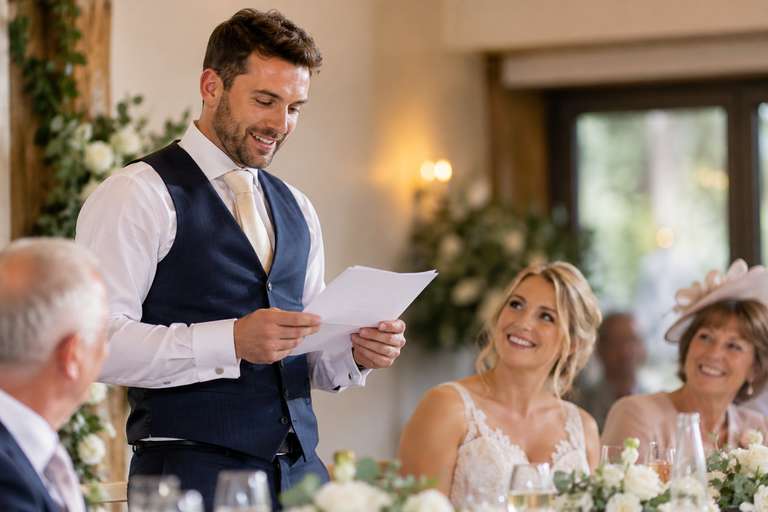
In my work helping people develop greater confidence, I’ve found that being nervous about public speaking doesn’t necessarily mean someone lacks confidence in other areas of their life. You might be perfectly comfortable talking to friends or colleagues, yet find the prospect of addressing wedding guests surprisingly frightening.
The good news is that there are practical ways to prepare, and understanding what makes the experience difficult for you can be just as important as writing the speech itself.
Remember What Your Speech Is Really For
One of the first things I’d encourage you to consider is what you actually want your speech to achieve. It might be to welcome people, thank those who have helped organise the wedding, share a favourite memory or tell someone how much they mean to you. You don’t have to achieve all those things.
A wedding speech isn’t an examination of your ability to entertain an audience. It’s an opportunity to contribute something personal to a celebration. Yet people sometimes place enormous expectations on themselves.
You might feel that your speech needs to be hilarious, moving, original and memorable. Perhaps you’ve watched other wedding speeches and wondered how you’ll ever manage something equally impressive. But think about the people you’re speaking to.
Would they really prefer a polished performance from someone trying desperately to be funny, or a few sincere words from someone they care about? I suspect most people would appreciate the latter.
Keep Your Speech Simple And Manageable
A speech doesn’t have to be long to be meaningful. In fact, when you’re nervous, knowing that you have a manageable amount to say can make preparation feel considerably less daunting.
Think about beginning with a brief introduction, sharing one or two things that matter to you and finishing with a few warm words or a toast, if that’s appropriate to the occasion. You might describe how you know the couple, mention something you admire about them or recall a memory that captures their relationship.
Try not to include every funny story or significant moment you can remember. Sometimes one carefully chosen memory tells people far more than several disconnected anecdotes.
And don’t feel obliged to become a comedian. If humour comes naturally to you, there’s nothing wrong with including something amusing. But if you’re uncomfortable telling jokes, you don’t need to make that part of your speech. It’s much easier to speak sincerely when the words sound like something you would actually say.
Should You Use Notes Or Read Your Speech?
People are sometimes told that a good wedding speech should be delivered from memory, with only a few notes to provide prompts. That may suit some speakers, but it certainly doesn’t suit everyone.
If you’re particularly worried about forgetting your words, having a written speech in front of you may help you feel more comfortable. There’s nothing wrong with that. You could print it in a large, easy-to-read font, leave plenty of space between paragraphs and mark where you’d like to pause.

Alternatively, you might prefer a few cards containing the main points. The important thing is choosing an approach that works for you rather than following somebody else’s rules about public speaking.
If you do use a complete script, practise looking up occasionally so you’re not concentrating entirely on the paper. But don’t worry about maintaining constant eye contact. A wedding speech isn’t a test of presentation technique.
Practise Speaking, Not Just Reading
There’s a difference between reading your speech silently and actually saying the words aloud. Something that looks perfectly natural on paper can feel awkward when spoken. You might discover that a sentence is too long, a particular phrase is difficult to say or you’ve included more detail than you really need. Practising aloud gives you an opportunity to make those adjustments.
I’d suggest rehearsing at a comfortable pace rather than trying to rush through everything. Allow yourself to pause between ideas. Imagine giving people a moment to appreciate a funny memory or something particularly heartfelt.
You can also practise with someone you trust, provided their feedback is likely to be helpful rather than making you more self-conscious. But there’s no need to rehearse so relentlessly that the speech starts to feel like something you must reproduce perfectly. You want to become familiar with what you’re saying, not frightened of making the slightest change.
Find Out What Will Happen On The Day
Uncertainty can make wedding speech nerves considerably worse. You might be imagining yourself standing in an unfamiliar room, wondering where to look, how loudly to speak or whether everyone will be able to hear you. A few practical questions can remove some of that uncertainty.
Find out roughly when the speeches will happen, whether you’ll be standing or sitting, and whether a microphone will be available. If possible, have a look at where you’ll be speaking before the guests arrive.
You might also want to check who will introduce you and whether there will be somewhere convenient to place your notes or a glass of water. These are small arrangements, but they can make the occasion feel more familiar. And familiarity can be particularly helpful when you’re already feeling nervous.
When The Wedding Day Arrives
Perhaps one of the most frustrating things about wedding speech nerves is how much they can affect the rest of the day. You might be sitting at a beautifully arranged table, surrounded by people you enjoy spending time with, yet barely notice what’s happening.
Instead, you’re wondering how much longer it will be before the speeches begin. You keep checking your notes or mentally repeating the opening sentence. By the time your turn arrives, you may feel as though you’ve already given the speech a dozen times.
This is a form of anticipatory anxiety, where worrying about an upcoming event can become more uncomfortable than the event itself.
I’d encourage you to remember that the wedding is much more than the few minutes you’ll spend speaking. You have every reason to enjoy the ceremony, the company, the meal and the conversations happening around you. Your speech is one part of the celebration, not the purpose of the entire day.
What If You Lose Your Place Or Become Emotional?
This is something many nervous speakers worry about. You imagine stopping halfway through a sentence, forgetting what comes next and watching everyone wait for you to continue. But a pause doesn’t have to become a disaster. You can look at your notes, take a moment and begin again.
If you become emotional while speaking about someone important to you, that’s understandable too. You don’t have to apologise repeatedly or struggle to disguise how you feel. And if you stumble over a word, you can simply correct yourself.
The difficulty often comes from believing that every hesitation will be noticed and judged. In reality, a wedding speech is a personal moment shared with people who have come together for a celebration. You don’t have to look perfectly confident throughout. You simply need enough comfort to say what matters to you.
When Preparation Doesn’t Seem To Be Enough
Sometimes people prepare their speeches carefully, practise aloud and make sensible arrangements, yet still experience considerable anxiety. You might know exactly what you intend to say but become frightened at the thought of everyone looking towards you. Perhaps you’re particularly worried about blushing, shaking or suddenly forgetting your words.
These difficulties are not always resolved by improving the speech itself. I’ve explored that experience more fully in my article about the fear of public speaking, which includes a letter from someone facing a similar situation.
When I work with someone experiencing these difficulties, I want to understand what happens when they imagine speaking, what they’re most concerned about and how those feelings affect them. Depending on their circumstances, I may use clinical hypnosis alongside practical therapeutic techniques and mental rehearsal.
This forms part of my wider work helping people with anxiety, adapted to the situations they want to feel more comfortable in.
The aim is to help them develop a more comfortable response to the situation, rather than simply teaching them how to deliver a better speech. And I don’t assume everyone needs the same approach. Someone frightened of forgetting their words may need something quite different from someone whose greatest concern is being watched.
Remember To Enjoy The Celebration
Imagine reaching the end of your speech, looking towards the people you’ve been speaking about and feeling pleased that you’ve said what you wanted to say. Perhaps it wasn’t perfect. You might have glanced at your notes more often than you’d planned or felt your voice become a little emotional. But you shared something meaningful.
And now you can sit down, enjoy the company around you and take part in the rest of the celebration. That’s a much more worthwhile goal than trying to deliver a flawless performance.
If your wedding speech nerves are making an occasion you care about feel frightening, and you’d like to explore whether hypnotherapy could help, you’re welcome to contact me. We can begin by understanding what you’re finding difficult and what would help you feel more comfortable.
Frequently Asked Questions
Begin by preparing a speech that feels manageable and natural to you. Practise saying it aloud, decide whether you’d prefer notes or a complete script, and find out where and when you’ll be speaking. These steps can reduce uncertainty, although they may not remove every feeling of nervousness.
There isn’t a fixed rule, and the appropriate length depends on the occasion and your role. For many speakers, around three to five minutes is a reasonable starting point. A short, sincere speech can be just as meaningful as a longer one, particularly if you concentrate on a few things you genuinely want to say.
Absolutely. There is no requirement to memorise your speech. Some people prefer a complete written version, while others feel comfortable using a few notes. Choose whichever allows you to concentrate on what you’re saying rather than worrying about remembering every word.
Becoming emotional during a wedding speech is understandable. You may be talking about someone you love or recalling an important moment in your lives. If you need to pause, you can take a moment before continuing. There’s no reason to treat showing emotion as a failure.
Hypnotherapy may help some people who experience considerable anxiety about speaking at weddings. I would want to understand whether your main difficulty involves being watched, physical nervousness, forgetting your words or anticipating the occasion. We can then explore approaches suited to your particular concerns.